The Glenfarclas 40 Year Old whisky labels
At the turn of the millennium, the Speyside distillers J & G Grant turned to three Scottish artists to dress one of their rarest bottlings. Bruce Thomson answered with Robert Burns.
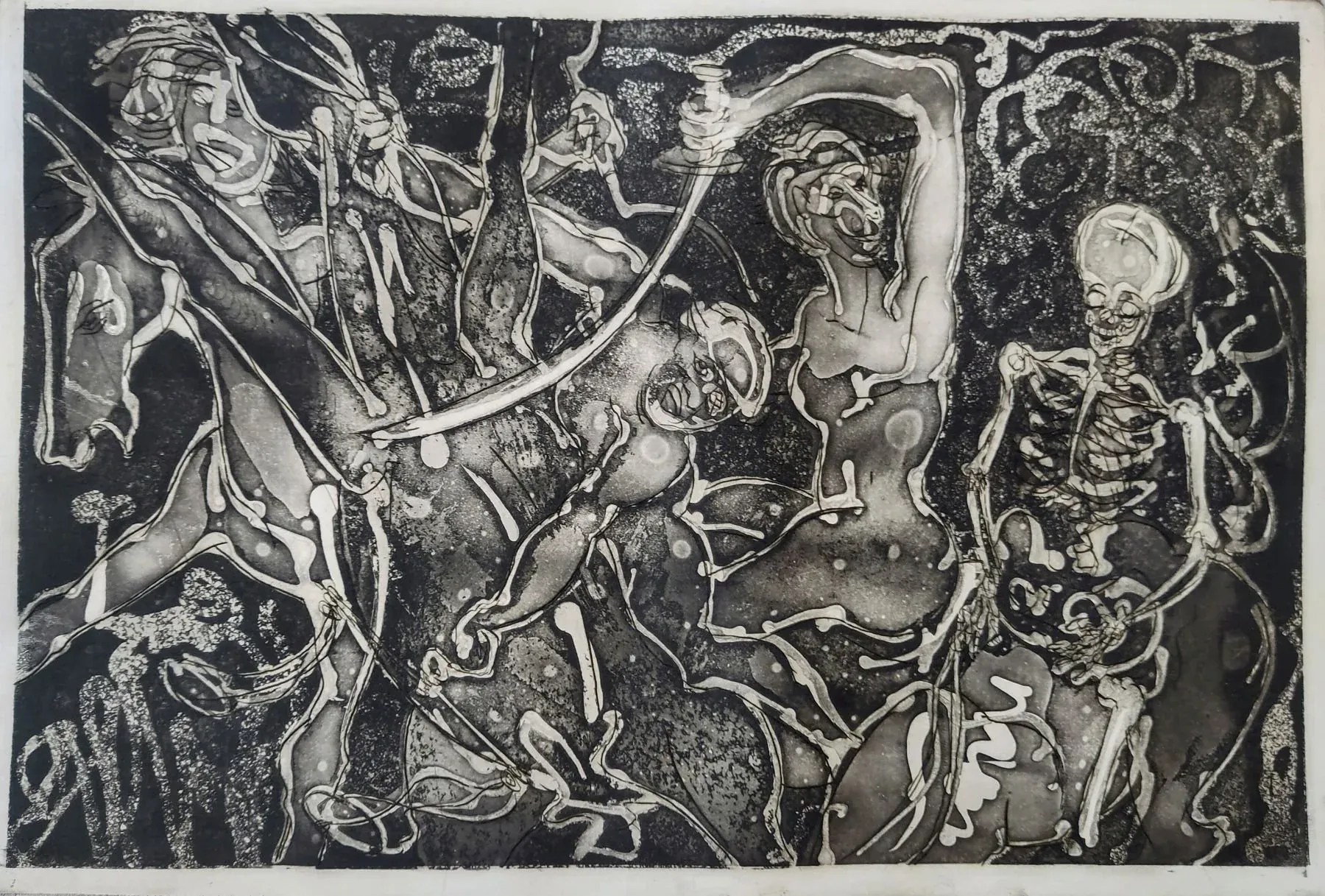
The Witches' Revelry, from Bruce Thomson's Tam o' Shanter series.
Some commissions ask an artist to invent something new. This one asked Bruce Thomson to return to ground he already knew. By the late 1990s he had been an etcher and printmaker for decades, and had already made illustrations of Tam o' Shanter, the Burns poem he loved. So when J & G Grant, the family distillers behind Glenfarclas, went looking for artists to mark the millennium, the fit was close to exact.
A malt dressed for the millennium
Glenfarclas had been maturing its 40 Year Old Single Highland Malt for four decades before it was bottled. To release it at the start of the third millennium, the distillery decided the whisky should carry more than a label. It should carry a piece of Scotland's cultural inheritance. J & G Grant commissioned three contemporary Scottish artists to illustrate scenes from classic Scottish literature, so that each bottle became an object of art as much as a dram.
The three artists were Stephen Shankland, Charles Hynes and Bruce Thomson. Between them they drew on the giants of the Scottish canon: Sir Walter Scott's Ivanhoe and Rob Roy, Robert Louis Stevenson's Treasure Island and Kidnapped, and Robert Burns' Tam o' Shanter and The Jolly Beggars. The full commission ran to a set of numbered, full-colour illustrations across a strictly limited run of the 40 Year Old.
"At the beginning of the third millennium it will also be seen as an ambassador for classic Scottish literature and contemporary Scottish art." — J & G Grant
Bruce opted for the two Burns works. It was a natural choice. Burns wrote in the vernacular of the same north-east Scotland where Bruce lived and worked, and the two poems he chose gave him exactly the raw material his line thrived on: movement, mischief, and a cast of characters caught mid-gesture.
Tam o' Shanter
Burns' 1790 narrative poem follows Tam, a farmer who lingers too long at the inn and rides home through a storm past the haunted Kirk of Alloway, where he stumbles on a witches' sabbath. He watches too long, is spotted, and is chased to the Brig o' Doon, his mare Maggie losing her tail to the pursuing witch at the last leap. It is a poem built for pictures: firelight and drink, a wild dance, a headlong midnight flight.
Bruce's etchings meet it on its own terms. In The Witches' Revelry the figures crowd and twist across the plate; the flowing, nervous line that runs through all his work turns the sabbath into pure motion. The images do not illustrate the poem so much as move with it.
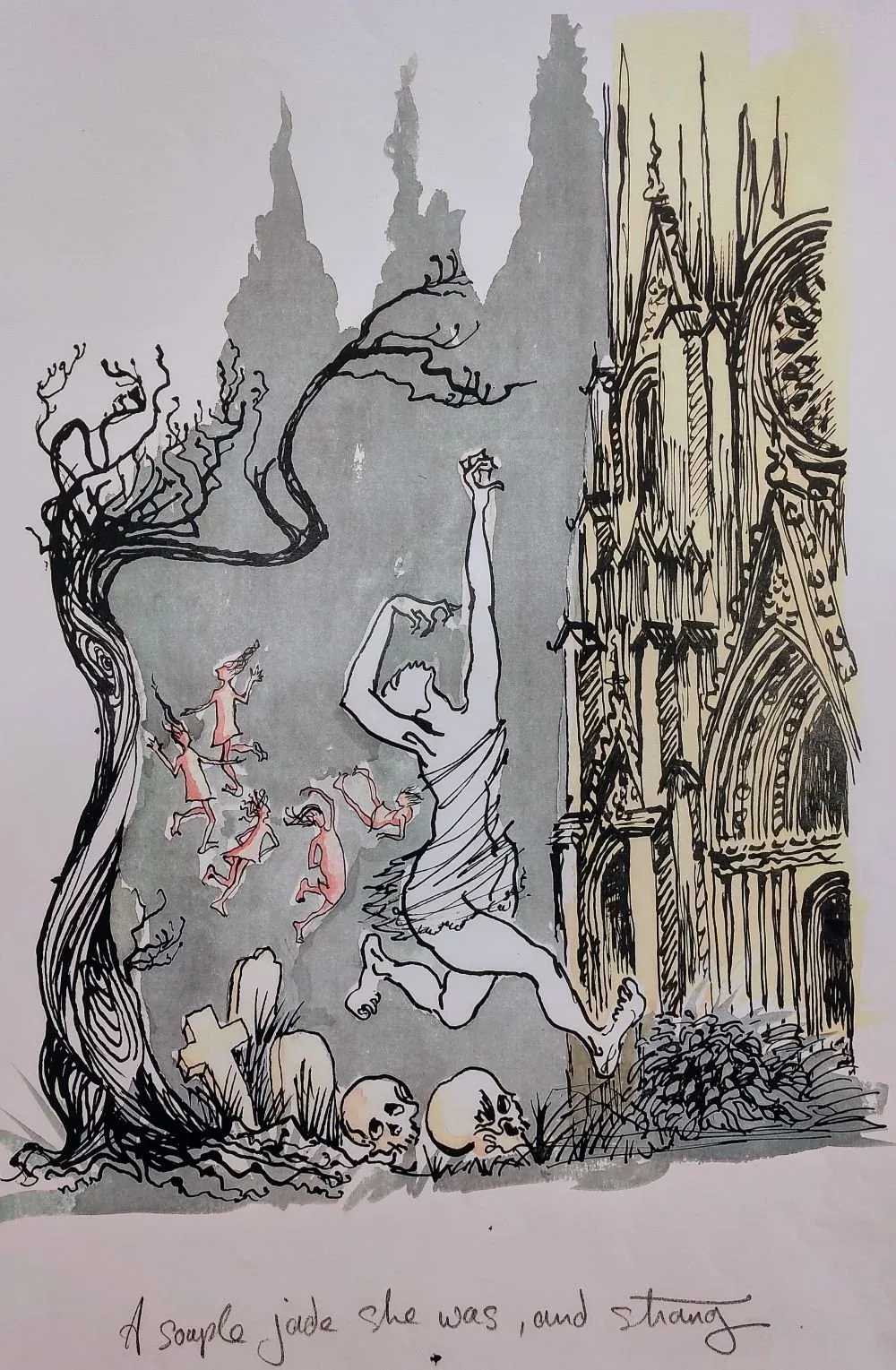
The Jolly Beggars
The second Burns work is a different register. The Jolly Beggars is a cantata of society's outcasts, a rowdy company of vagabonds, old soldiers and revellers singing in a tavern. Where Tam is a chase, this is a carnival. Bruce's illustrations lean into the noise of it, the beggars dancing and singing with abandon, their hardship never quite dimming the revelry.
Placed side by side on the Glenfarclas releases, the two poems let Bruce show both halves of his range: the dramatic sweep of the chase and the crowded human comedy of the tavern.
Why the bottles became collectors' pieces
Only a small number of the Glenfarclas 40 Year Old were ever bottled, and each carried one of the commissioned illustrations as a numbered, limited edition. That scarcity, combined with the literary and artistic pedigree, made them sought after twice over: by whisky collectors chasing a rare Speyside 40 year old, and by admirers of the art on the label. Bottles from the series have since been valued at up to €5,995 each.
For Bruce, the commission remains the clearest bridge between the gallery and the wider world. The same etchings hang as works in their own right, but for a generation of whisky collectors his name first arrived wrapped around a bottle.
See the work
The full commission, and the story of the release, has its own feature page on the Glenfarclas 40 Year Old. The individual plates live in the etchings collection, and the complete set of Burns illustrations sits in the illustration gallery alongside the drawings Bruce sent home to his children from the North Sea.